

The Profile That Wins Scholarships in 2026
What the scholarship committee looks for when making decisions


Everyone can win scholarships.
I used to think that scholarships were only for people with at least a 2-1 or first class. This means you have at least a 3.5/5.0. So far, I’ve interviewed 3 people who got scholarships with a low GPA (2-2). Aaron (Mathematics), Blessing (Applied Statistics), and Olusola (Biomedical Engineering). Having a high GPA is good, but winning scholarships isn’t about your GPA. There is something else.
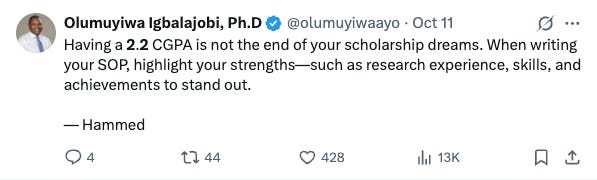
I also used to think that only first-class holders (above 4.5/5.0) can get a fully funded PhD straight from undergrad. Till I held visa interview coaching for 3 different scholars who didn’t match that profile. Two of them got it with only a 2-1, and one of them with an HND (Higher National Diploma). This made me really curious about what the committee actually looks for. I found something really interesting.
The strength of your profile and the competition level of the scholarship are the major determining factors. Competition depends on where you apply. Getting into Stanford for a master’s in accounting is tougher than getting into the same program at Augusta University. You need a stronger profile for Stanford.
Getting scholarships requires intentionality. You need to match your profile to the right competition level. The same profile can get accepted and rejected in different places. I applied with the same profile for a PhD in Data Science at the University of Buffalo and Clemson University. I got rejected at Buffalo but was fully funded at Clemson University.
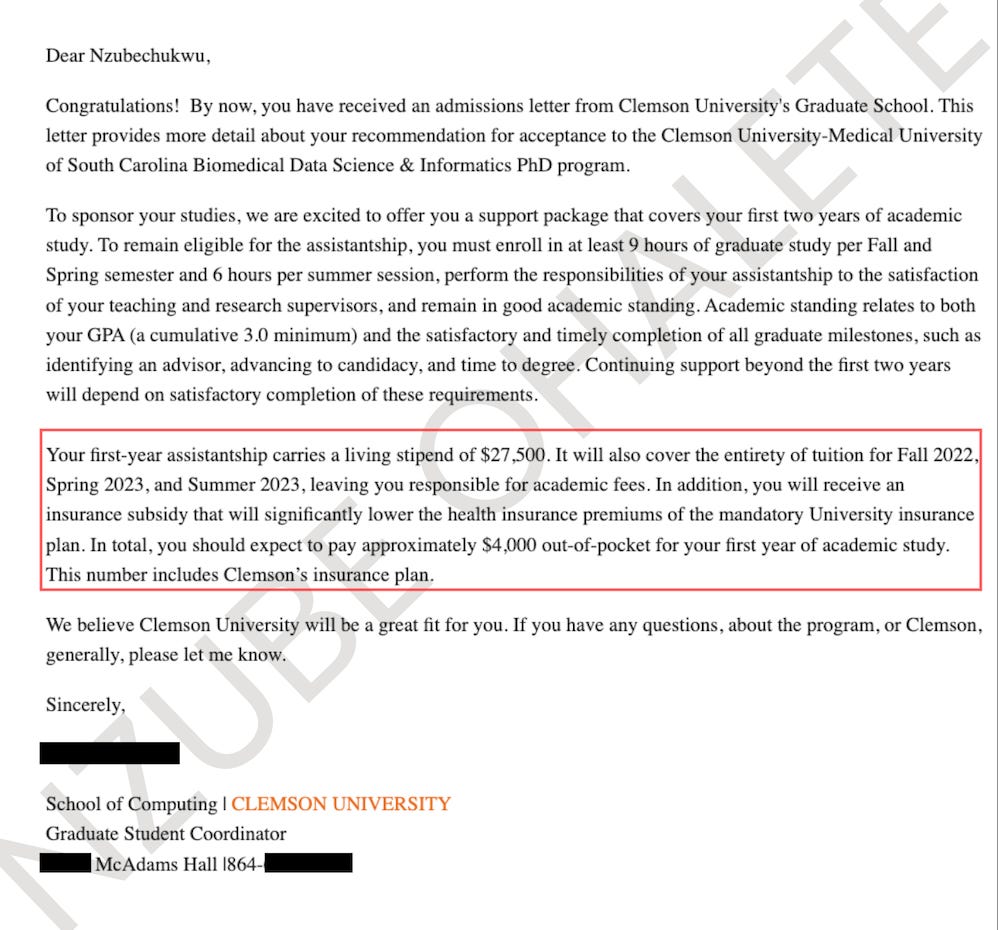
Your profile might already be strong; you’ve just been applying to the wrong places. The US alone will award over 1.7 million scholarships and fellowships in 2026. That’s worth more than $7.4 billion. These scholarships are spread across different programs/universities.
Today, let’s position you to get a slice of that pie. The scholarship committee considers various factors in each document you submit. Understanding this gives you insight into their thought process.
Application Packet
When applying for any scholarship, you’ll be required to submit some documents. All documents play different roles in your application packet. They guide different parts of the application decision. Let’s understand what each document is doing.
Academic Certificate and Transcripts. This shows that you have studied the foundational courses needed to thrive in that program. It could be from your bachelor’s and master’s degrees. It also shows how well you perform academically. A high GPA is always a good thing in every academic circle.
Academic CV. This shows your experience and achievements in an orderly way. A good academic CV contains important details. Your education, honors and awards, work experience, teaching experience, research experience, skills, publications, and so on. The best predictor of the future is the past. Your CV shows your past and your track record.
Statement of Purpose (SOP). Also called a Goal Statement, Personal Statement, or Motivational Letter. It is your unique story. It shows the committee who you are and why you deserve a place in their program. What are your motivations? What are your short-term and long-term goals? How is our program a good fit for you? How can you contribute to this program? This is mainly needed when applying for internal scholarships. A good example is graduate assistantships in the US/Canada. The department funds you, so you have to show a strong fit for the program.
Essays. This is mainly for external scholarships. Some examples are: Mastercard Foundation Scholarships (Multiple countries), Chevening Scholarships (UK), Commonwealth Scholarships (UK), SI Scholarships for Global Professionals (Sweden), and Erasmus Mundus Joint Masters (Europe). They have essay prompts and require stories from you to show that you are the one they’re looking for. Every external scholarship is set up to fund a particular mission/goal. The essays show that you are already successfully doing what they are looking for. You are successful in the criteria they look for. Different scholarships have different criteria. Chevening and the Commonwealth are from the same UK government but very different. Commonwealth rewards academic excellence, and Chevening rewards societal impact. A first-class graduate without societal impact won’t get Chevening. A 2-2 graduate who owns an NGO that has done projects to affect 3,000 people in their community will.
Passport. This is the legal proof of identity issued by your country. We call this an “international passport” in Nigeria. Some external scholarships (e.g., SISGP) require this when you apply. It shows you meet the nationality requirement. Some scholarships are set up for specific nationalities.
Recommendation letters (2-3). This shows what others have to say about you. Are you really who you claim to be in your essays? The experts have accomplished significant things in their fields. And they’ve also worked with you in the past. This makes what they have to say about you really important.
Tests like the GRE or GMAT. This is mostly needed in the US, Canada, and some schools in the UK. It is an IQ test showing your mental preparedness for that program. For example, my program (PhD in Data Science at KSU) requires a minimum quantitative score of 160/170 in the GRE. Data Science requires an analytical mind, which is why this requirement is there. You see something similar for some other programs.
Proof of English Proficiency, such as TOEFL, IELTS, or Duolingo. This shows how proficient you are in English. Each test assesses your speaking, writing, listening, and reading. Most programs use it to gauge how well you can learn in English. US/Canadian universities are now waiving this based on your nationality. But some schools go the extra mile to require that all Teaching Assistants (TAs) should have it. TAs are a form of graduate assistantships.
Writing sample. Some programs require this. It shows how good you are at academic writing. Academic writing is different from social media writing. Usually, if you’ve done a final year research project, it serves as academic writing.
Research proposal. This is also only required by some PhD or Master’s by research programs. It shows how thoroughly you have thought out a research problem and the method you intend to use to solve it.
Publications. A publication is a research work that has been published in an academic journal. This is an example. This shows very good research experience, especially if it was published in a top-tier journal. Not everyone applying has publications. But if you do, it’s an added plus. More on this later.
Depending on the scholarship you’re applying for, they’ll require a combination of the documents above. Even if you have all these documents, you still need to stand out in a few of them. Scholarships are only given to scholars. Let’s talk about how you can show you’re a scholar.
Standing Out From The Crowd
Many people still get rejected even after submitting all the application documents. The reason is simple. They’ve not shown that they are exceptional in any way. I have seen five areas where you can show you’re exceptional. You mustn’t be exceptional in all, but you must stand out in at least one. The more the better.
CGPA. This stands for cumulative grade point average. It applies to either your bachelor’s degree and/or master’s degree (if you have one). It’ll be written on your transcript. You need to have a high CGPA. But what does that even mean? Generally speaking, you should have at least a 4.0/5.0 (or 3.4/4.0). Obviously, the higher the better. You can use this free WES CGPA calculator to convert your CGPA to a 4.0 scale (used in the US/Canada). Here is a thread to guide you on the conversion.
Relevant work experience. For this point to count, it has to be relevant to the course you’re applying for. If I’ve worked 5 years as a civil engineer and I’m applying for a master’s in computer science, it doesn’t count. You need at least 3-5 years of relevant work experience to be exceptional here. Also, what makes you exceptional isn’t just the duration, but the achievements you’ve made in those years. That’ll be obvious on your academic CV and SOP.
Publications. This is especially helpful if you’re going for a PhD. A traditional PhD is a research degree. Now there are professional PhDs, but that’s not what we are talking about here. Having two publications makes you exceptional. It shows strong research experience, as you’ve completed the research pipeline from start to finish. A research project is considered finished when it’s published in a journal.
Community projects. Some scholarships, such as the Chevening Scholarship, specifically recognize this. If you’re exceptional in this, you can get the scholarship even if you don’t meet the other points above. Being exceptional here means you led the project. It was your initiative, and it changed the lives of some people in some way. You participating a few times (probably during your NYSC) doesn’t carry as much weight as owning it.
Tests like GRE/GMAT. This is another way to stand out. I consider it the fastest way. The others take at least a year. This can be gotten in one month if you prepare appropriately. For it to count, you need to apply to a program that requires it or makes it optional. Some programs don’t require it again and won’t consider it if you submit. Based on my observation, getting anything above 310 is good. If you get above 320, you’re more competitive.
Bottom Line
When you have a strong profile, all that’s left is strong positioning. Apply to a place where your profile would be competitive. Competition depends on where you apply, so always evaluate the competition level before applying. Two ways to do this is to:
Check the program or university’s acceptance rate.
Check the program or university’s ranking.
All this information is available through a simple Google search. This also mostly applies to internal scholarships offered by programs. All external scholarships are highly competitive. Keep putting your A-game in every application. Share this newsletter with a friend who’ll consider this helpful.
That’s it. See you next Sunday.
Weekly Scholarship Highlight

This week, check out the Commonwealth Shared Scholarships, one of the largest fully funded scholarships to study in the UK.
Application window: November 12 to December 9, 2025.
If you found this post helpful, you can share it with your friend:
If this was forwarded to you, you can subscribe here:
Whenever you’re ready, there are 4 ways I can help you:
The SA Scholarship Bootcamp: This 6-week Bootcamp is designed to help you secure fully funded master’s and PhD scholarships in Canada and the US with expert guidance every step of the way. The Bootcamp 3.0 started on October 18th, 2025, and late registration ends today.
US Scholarships Self-paced Masterclass: This self-paced masterclass shows you the 14 steps you need to get fully-funded US scholarships for master’s and PhD - no matter your CGPA. Getting US scholarships is much easier than you think.
F1 Visa Interview Consultation: Get your F1 visa in your next interview. I combine my five F1 visa interview experiences with my expertise in learning from visa officers to prepare you for your visa interview thoroughly. We will identify your strengths and prepare you to deliver them confidently. Your story is the secret to your visa approval.
Scholarships Clarity Call: This is a one-on-one, 30-minute conversation where we’ll discuss your specific situation—your background, goals, and the biggest obstacles standing in your way right now. By the end of the call, you’ll know exactly which scholarships you should be targeting, what’s missing from your profile, and the next three steps you need to take to move forward.